
PARIS — I to årtier har Freitags installation af 19 nedlagte fragtcontainere stablet i et tårn præget af rustpletter i Zürichs tidligere industriområde stået som et detaillandemærke.
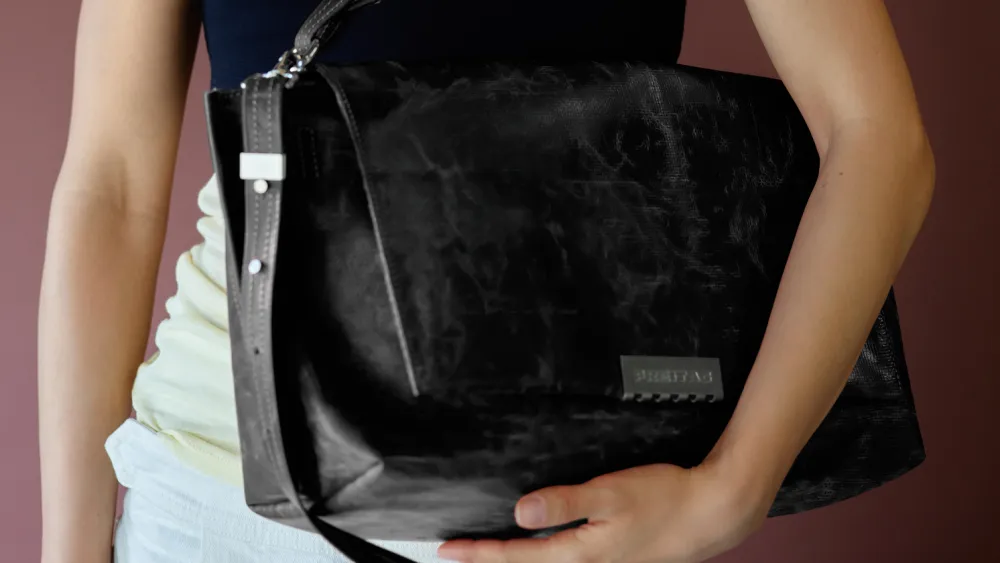
Den butik fejrede sin 20-års jubilæum i september, og den schweiziske taskemager bruger milepælen til at markere sit næste skridt med lanceringen af Reference-linjen, en række af fire tasker skabt for at løfte opcykling mod et mere raffineret, minimalistisk design.
Brandet, grundlagt i 1993 af brødrene Markus og Daniel Freitag, er et af de oprindelige bæredygtige mærker. De begyndte med at lave forladte lastbilpresenninger om til unikke tasker, før “bæredygtighed” var på nogens radar.
Reference-linjen, som lanceres torsdag, udvider nu denne cirkulære materiale-filosofi og bevæger den videre, idet bæredygtighed måske er mere kendt som et buzzword, men i øjeblikket udfordres på forbrugermarkedet.
You May Also Like
“We prove that upcycling and elegance are not a contradiction,” said Freitag chief executive officer Janine Weiz-Bühler. “Used truck tarpaulins are every bit the equal of classic luxury materials when worked with the dedication and refined craftsmanship Freitag built over the past three decades.”
Firmaets Zürich-flagskib forbliver brandets detailudtryk. Oprindeligt var den tiltænkt som en midlertidig installation, butikken åbnede i 2006 og fik til sidst permanent godkendelse i 2014.
Et Repair Kiosk åbnede ved siden af i 2025 og gjorde stedet fra et konventionelt indkøbssted til et knudepunkt for reparation og cirkulære tjenester.
“To this day it remains not only a bold architectural statement, but a tangible embodiment of our purpose: ‘we think and act in cycles,’” said Markus Freitag.
Freitag driver nu 30 butikker verden over, primært i Europa og Asien, sammen med et netværk af omkring 200 detailpartnere og sin onlinebutik.
Den detailstrategi har siden udvidet sig langt ud over salg af tasker. Butikkerne fungerer også som knudepunkter for reparation, udlejning, videresalg og byttebegivenheder.
Men økonomien i en cirkulær model er ikke ligetil. Opcykling af sin kerneråmateriale koster omkring tre gange mere end at købe nyt materiale, forklarede Markus, fordi presenningerne skal indkøbes fra hele Europa, kvalitetstjekkes, adskilles i hånden og vaskes inden produktionen.
Men virksomheden ser den arbejdskraftintensive proces som en kommerciel differentieringsfaktor, fordi den skaber tasker med individuel karakter i stedet for standardiseret produktion.
“We call the approach ‘profit for purpose’,” Markus said. “Economic health is the foundation to amplify our positive impact, and financial success is not the ultimate goal, but the engine that gives us the independence to go for bold innovations.”
The company is consequently pursuing value growth without relying solely on higher volumes.
“Pure volume-driven growth definitely clashes with planetary limits,” Markus said. For the brand, he added, growth means “elevating our omnichannel distribution and expanding our global community to gain visibility for a good purpose, rather than just pushing more product.”
“At the same time, we have to be honest — operating in an ecologically responsible way does put pressure on margins,” he added. “However, that individual character [of each bag] creates a very strong personal connection with our customers, transforming the major operational effort into our greatest brand strength.”
The Reference line is the next step in expanding that value growth and brand loyalty. Each uses hand-selected, monochrome truck tarp and is manufactured in small series through European production partners.
The range is intended to reach new customers who may not immediately vibe with Freitag’s traditionally colorful and utilitarian aesthetic.
“From a commercial standpoint, the relaunch of Reference represents a strategic expansion of our lineup into an even more premium, more minimalist segment,” Weiz-Bühler said. “The elevated, understated design language allows us to attract entirely new target audiences who value quiet quality and versatility in their daily lives.”
Still, the company is careful not to frame Reference as a rebrand.
“This isn’t a shift in our market positioning or a rebrand — rather, it expands our versatility,” Weiz-Bühler said. “We want to demonstrate that sustainable design solutions belong in every segment.”
The three-R slogan of sustainability — reduce, reuse and recycle — is embedded in the product itself. Each Reference bag comes with a detachable repair kit made from the same tarp as the bag, including original lining and sewing thread, so the owner can repair it years later if needed.
“While we aim for cost-neutrality with these services, the overall ecosystem value — keeping products in circulation and building trust — makes them a solid long-term investment,” Markus added. “Ultimately, it helps us build even deeper customer relationships and brand loyalty that money can’t buy in standard retail.”
The company’s overall goal is to move from upcycling into genuine material circularity. To that end, it’s developing a “circular tarp” with industry partners that could eventually be recycled at the end of its life. The first prototypes are already being road-tested.
It’s also experimenting with mono-material products. Its aptly named “Mono” backpack is made entirely from a single recyclable material and can be shredded and processed back into polyamide-nylon granules at the end of its life.
But the company acknowledges that circularity is structurally difficult for fashion. Rental and repair are labor- and cost-intensive, while recycling requires specialized infrastructure that does not yet exist at scale, plus closing the consumer awareness gap.
“Some brands still treat sustainability as an afterthought or a pure marketing tool. When a brand just wraps a sustainability story around its existing business model, it inevitably hits a wall because the underlying engine remains optimized for volume, rapid obsolescence and margin maximization,” Weiz-Bühler said.
“True sustainability cannot simply be bolted on, rather it must be the starting point for every product design and operational decision. Of course, all of this is easier said than done…[but] we hope Freitag can serve as an inspiration for a more future-proof way of producing and consuming,” she added.
The brand hopes to build on the current, well, climate. After Europe’s hottest summer on record, extreme heat has become a major talking point.
“This makes our model even more relevant: as the climate challenges are getting more pressing and greenwashing faces well-deserved scrutiny, people are seeking out sustainability pioneers with authentic substance and experience,” Weiz-Bühler said.
